Guide · Redemption
What it actually costs to ship your cards home
Redeeming a card — having the physical slab shipped to you instead of selling it back on the platform — costs anywhere from $5.99 to $45.00 for a single card, depending on the platform and where you live. On a cheap card that is more than the card is worth. These are quotes we pulled ourselves from live accounts on , not figures copied off a help page.
The short version. For a single card, Collector Crypt is cheapest. For a bulk redemption, Courtyard wins by a wide margin — their shipping barely moves with card count while everyone else charges per slab. MNSTR is the most expensive at every size we tested. Import tax is a separate question and it changes the answer again.
Shipping, head to head
This table is shipping only. Tax is deliberately excluded because the three platforms handle it completely differently — mixing it in makes one platform look expensive when it is simply the only one telling you the whole bill. Tax gets its own section below.
| Redemption | Collector Crypt | Courtyard | MNSTR |
|---|---|---|---|
| United States1 card | $5.99 | $7.01–$7.69 | $25.00 |
| United States5 cards | $17.99 | $7.01 | $45.00 |
| United States19 cards | $59.99 | $7.30 | $115.00 |
| Australia / New Zealand1 card | $34.99 | $30.20 | $45.00 |
| Australia / New Zealand19 cards | $88.99 | $33.89 | $135.00 |
Collector Crypt and MNSTR computed from their published rate structures. Courtyard shows what we were actually quoted — they publish no rate card. MNSTR’s US base rate is platform-stated, not yet confirmed against an individual quote.
Strip the tax out and the shape of the market is obvious. Courtyard barely charges for volume. Nineteen cards to Australia quoted $33.89 against a single card at $30.20 — for eighteen extra slabs. Collector Crypt and MNSTR both bill per card, so the same nineteen-card redemption runs $88.99 and $135.00 respectively.
The reverse holds for a single card, where Collector Crypt’s $5.99 US rate beats everything. So the practical rule is: redeem one card on Collector Crypt, redeem many on Courtyard. MNSTR does not win either scenario, and its per-card charge applies to the first card too, which makes small redemptions especially poor value there.
Collector Crypt: a formula you can check
Collector Crypt charges a flat base by destination plus $3.00 for every card after the first. The cost is fully predictable before you commit, which is worth crediting — the table below is arithmetic, not an estimate.
| Destination | 1 card | 3 cards | 10 cards |
|---|---|---|---|
| United States | $5.99 | $11.99 | $32.99 |
| Canada | $20.99 | $26.99 | $47.99 |
| Europe | $29.99 | $35.99 | $56.99 |
| Australia / New Zealand | $34.99 | $40.99 | $61.99 |
| Rest of world | $34.99 | $40.99 | $61.99 |
Three surcharges sit on top of that table, all from Collector Crypt’s own shipping API documentation: signature on delivery adds $3.00 on US packages worth $500.00 or more; insurance auto-applies at 0.5% of declared value once a package exceeds $5,000.00; and sealed packs carry a small per-pack surcharge ($0.18 in the US, $0.25 elsewhere). A $10,000.00 card to a US address therefore ships for $58.99, not $5.99.
There is no 2% vault withdrawal fee.Several third-party sites — including some large ones — state that Collector Crypt charges 2% of a card’s insured value to withdraw it. We went through the entire redemption flow to the payment step on and no such fee appears. The cost was shipping, and nothing else. On a $500.00 card that claim would have added $10.00 and moved every break-even figure on this page.
We mention it because the claim is repeated widely enough that you may have read it, and because it is a fair illustration of why we do our own checking: a number can be everywhere and still be wrong.
How long it takes depends on which vault holds the card
Lead time is set by where the slab is stored, not by what you paid. Collector Crypt quotes roughly one week from its own Omni Vault, two weeks from Fanatics, and three weeks from PSA — with a further one to two weeks for international destinations. A PSA-vaulted card heading to Australia is realistically a four-to-five week wait.
Courtyard: no rate card, but volume is close to free
Courtyard quotes each redemption individually and publishes no rate structure, so everything here is observation. Across nine quotes in a day, US shipping landed between $7.01 and $7.69 for one, four, five and nineteen cards alike — and mixing graders made no difference, with a four-card single-grader quote and a five-card two-grader quote both returning $7.01.
| Destination | Cards | Shipping | Tax |
|---|---|---|---|
| United States1 PSA card | 1 | $7.01 | $0.00 |
| United Statesto California | 1 | $7.69 | $0.00 |
| United States1 PSA + 2 CGC — ANOMALOUS, not reproduced in later quotes | 3 | $24.98 | $0.00 |
| United Statesfull collection to California — ANOMALOUS, same collection later quoted $7.30 | 19 | $12.87 | $0.00 |
| United States4 CGC slabs — single grader | 4 | $7.01 | $0.00 |
| United States4 CGC + 1 PSA — two graders, identical price to single-grader | 5 | $7.01 | $0.00 |
| United Statesfull collection, CGC + PSA — re-quote of the $12.87 anomaly | 19 | $7.30 | $0.00 |
| Australia / New Zealand | 1 | $30.20 | $2.90 |
| Australia / New Zealandfull collection | 19 | $33.89 | $103.12 |
Quotes taken 2026-08-03. Greyed rows are two quotes we could not reproduce — kept in the record rather than deleted. Optional package coverage costs 10% of the value covered and is excluded above.
Two early quotes — $24.98 for three cards and $12.87 for nineteen — came back far above everything measured since, and the same nineteen-card collection later quoted $7.30. We cannot explain them. Courtyard documents a $2 per card handling surcharge during periods of high demand, which is the only published mechanism that would move a quote upward without notice, though neither figure matches base plus $2 a card. Treat their quotes as a snapshot, not a rate.
Other Courtyard terms worth knowing before you redeem
- Redemption requires KYC, and identity verification happens after you submit the request, not before.
- A $2 per card handling fee applies during periods of high demand — described as temporary, so a quote taken today may not hold next week.
- US packages generally arrive within about 10 business days of invoice processing. International is longer and they publish no figure.
- You cannot redirect a redemption to an alternate Brink's location — stated explicitly as an anti-abuse measure.
MNSTR: the simplest formula, and the priciest
MNSTR charges a destination base plus $5.00 per card — and unlike Collector Crypt, that per-card charge applies to every card including the first. Three Australian quotes fit it exactly: one card $45.00, ten cards $90.00, eighteen cards $130.00.
| Destination | 1 card | 5 cards | 18 cards |
|---|---|---|---|
| United States | $25.00 | $45.00 | $110.00 |
| Australia / New Zealand | $45.00 | $65.00 | $130.00 |
Australian figures verified against three quotes. US base rate as stated on the platform, not yet confirmed against an individual quote. Other destinations untested.
One thing MNSTR does better than either rival: their founder states shipping is a fixed price regardless of which vault holds the card, and that the platform loses money on it. Collector Crypt’s price is also vault-independent, but its lead time is not.
gacha.game: the most expensive single card we have shipped anywhere
We ran a real redemption. One card, to Sydney. gacha.game quotes several couriers and adds a $0.10 redemption fee on top:
| Courier | Shipping | Est. delivery |
|---|---|---|
| Aramex – Parcel | $39.15 | 8 days |
| DHL Express Worldwideplatform default | $46.72 | 4 days |
| UPS Worldwide Expedited | $156.79 | 6 days |
| UPS Worldwide Saver | $160.69 | 3 days |
Quoted 2026-08-05 on a live single-card redemption. Plus a $0.10 redemption fee.
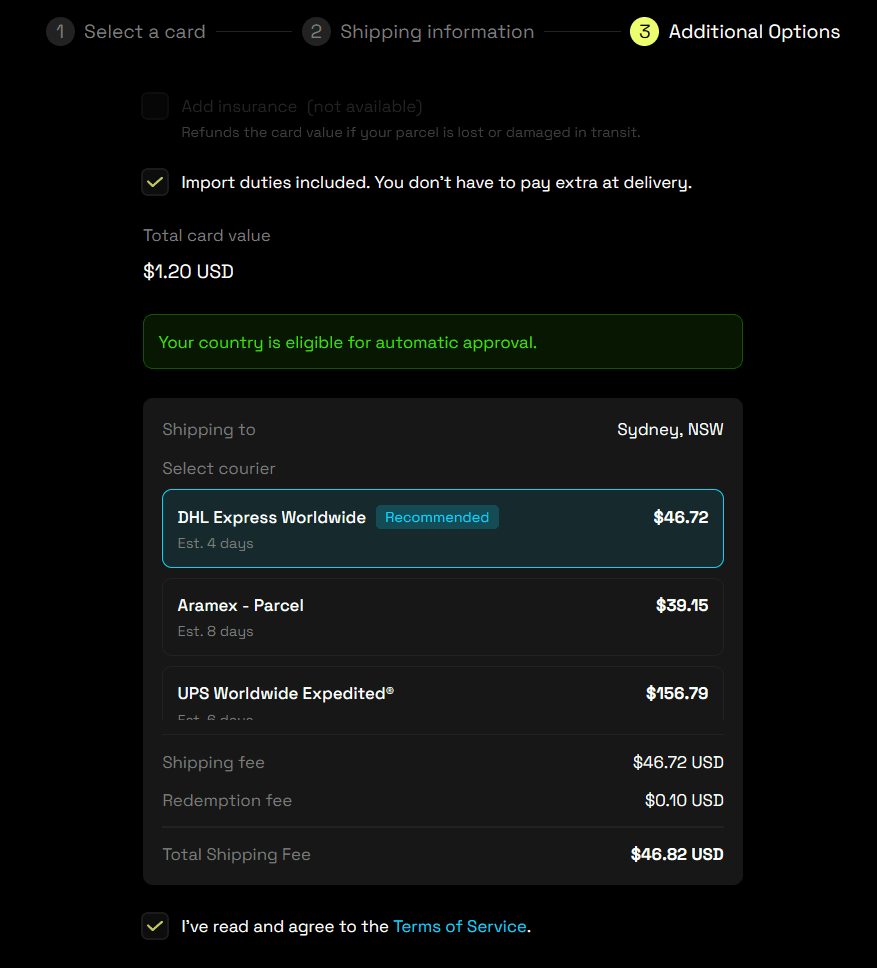
The default option totals $46.82 — more than Collector Crypt ($34.99), MNSTR ($45.00) or Courtyard ($33.10 including tax) charge for the same job. Taking the cheapest courier instead saves $7.57 at the cost of four extra days, and the two UPS options are worth avoiding entirely at over $156.00 for a single card.
The card we redeemed was worth $1.20. That is not a criticism of the shipping price so much as an illustration of the arithmetic this whole page exists to make visible: below a certain card value, redemption is not a decision worth making. Our $1.20 card would have cost $46.82 to bring home.
US buyers get a worse experience still. Australia is auto-approved and quotes instantly. The United States requires a manual quote request, so an American buyer cannot see what redemption costs before committing to ask. Every other platform we have priced quotes the US immediately.
Tax: a completely separate question
Two of the three platforms do not charge tax at checkout. That is not the same as there being no tax to pay, and it is the single biggest reason a shipping quote can mislead you about what a redemption costs.
Collector Crypt
Does not quote it
States customs duties, VAT and import taxes are the buyer's responsibility. Anything owed arrives later, from the carrier.
MNSTR
Does not quote it
Same position: you accept responsibility for any customs fees, duties, or import taxes at checkout.
Courtyard
Collects upfront
Calculates and collects at checkout, so an international buyer sees the real total before committing.
gacha.game
Offers DDP
Delivered Duties Paid shipping where available — you prepay duties and taxes so nothing arrives later. The best handling of this problem we have found.
The comparison people get wrong: eighteen cards to Australia costs $85.99 on Collector Crypt against $137.01 on Courtyard — until you notice $103.12of Courtyard’s total is tax that Collector Crypt has simply not charged. One figure is a shipping quote and the other is a landed cost. They are not comparable, and a platform that declines to collect tax has not saved you anything it has only moved where the bill appears.
On the narrow question of whether a bill can arrive after delivery, the order is: gacha.game’s prepaid duties, then Courtyard’s upfront collection, then Collector Crypt and MNSTR, which quote nothing and leave it at the border. Worth weighing against shipping price rather than instead of it — Collector Crypt is far cheaper on the shipping line and far less certain on the total.
One gacha.game caveat from their own documentation, because it is the kind of thing that catches people: cards sit in either a Hong Kong or a US vault, and they warn that “shipping items from Hong Kong vault to US is subjected to high tariff.” You do not choose which vault holds a card, so a US buyer can inherit a tariff from an allocation they had no say in. Check the vault before redeeming.
How Courtyard’s tax is actually calculated
Their Australian quotes returned $2.90 of tax on $40.00 of cards and $103.12 on $1,600.00— implied rates of 7.25% and 6.45%, neither matching Australia’s 10% GST. The missing piece is in Courtyard’s own documentation: tax is charged on the monetary value of the last sale of the asset, not on what the card is worth today.
Apply their published 10% Australian rate to a last-sale basis and both quotes reconcile exactly — $2.90 implies a $29.00 last sale, $103.12 implies $1,031.20. The rate was never unusual. The practical consequence: a card that has appreciated since it last traded is taxed on the old, lower price.
US buyers face a different mechanism again — domestic redemptions are charged state sales tax by ZIP code rather than import duty, which Courtyard says it collects, remits to the states, and makes no money on, on the same legal basis eBay and Amazon operate under.
| Country | Rate | Minimum threshold | On a $500 last sale |
|---|---|---|---|
| United States | 0% | 800 USD | $0.00 |
| Australia | 10% | 0 AUD | $50.00 |
| New Zealand | 15% | 0 NZD | $75.00 |
| Canada | 5% federal (provincial rates vary) | 20 CAD | $25.00 |
| United Kingdom | 20% | 0 GBP | $100.00 |
| Germany | 16% | 0 EUR | $80.00 |
| Japan | 10% | 10,000 JPY | $50.00 |
| Singapore | 7% | 400 SGD | $35.00 |
| Brazil | 17–19% | 0 BRL | — |
Selected markets from Courtyard’s published country table, read 2026-08-03; their full table covers roughly 200 countries. Ranges are published that way and we do not resolve them to a single figure. These are the rates one platform applies — not tax advice, and not a substitute for your own country’s rules.
When is shipping the card home worth it?
Redeeming competes with selling the card back on the platform. Selling back is instant and free but returns less than the card is worth; redeeming gets you the whole card but costs shipping. So redemption wins once the value you give up by selling exceeds the shipping bill:
break-even card value = shipping ÷ (1 − what selling back returns)
Below the break-even, shipping costs more than the spread you avoid. Here is that threshold for Collector Crypt’s verified one-card rates:
| Destination | Sells back at 70% | Sells back at 80% | Sells back at 85% | Sells back at 90% |
|---|---|---|---|---|
| United States$5.99 shipping | $19.97 | $29.95 | $39.93 | $59.90 |
| Canada$20.99 shipping | $69.97 | $104.95 | $139.93 | $209.90 |
| Europe$29.99 shipping | $99.97 | $149.95 | $199.93 | $299.90 |
| Australia / New Zealand$34.99 shipping | $116.63 | $174.95 | $233.27 | $349.90 |
| Rest of world$34.99 shipping | $116.63 | $174.95 | $233.27 | $349.90 |
The sell-back rates across the top are a range, not a quote. Rates vary by pack and by platform, and we have not yet verified Collector Crypt’s from primary sources — so rather than publish one number we cannot stand behind, the table shows what the threshold becomes at each. Find the rate your pack actually offers and read across.
One result surprises people: a better sell-back rate makes redemption less attractive, not more. At 70% you forfeit 30 cents on the dollar by selling, so shipping pays for itself quickly. At 90% you only forfeit a dime, and an Australian buyer needs a card worth roughly $349.90 before shipping it home is the cheaper exit.
This is the arithmetic only. Plenty of people redeem because they want the card in hand, and that is a perfectly good reason no spreadsheet is going to capture. What the table tells you is what that preference costs.
What we still don’t know
- What Collector Crypt's and MNSTR's international redemptions actually cost once customs bills land. Neither quotes tax, so the real figure is only knowable on delivery. Our own redemptions are in transit and we will publish the invoices.
- What caused Courtyard's two unreproducible quotes. Their documented high-demand handling surcharge is the best candidate, but the numbers do not fit it cleanly.
- MNSTR's US base rate against an individual quote, and its cost to any destination outside the US and Australia.
- Courtyard's international lead times, which they do not publish.
- Whether Courtyard's roughly-$7 US shipping holds outside the single day we sampled.
All quotes first-hand, taken 2026-08-03 · we update this page when we re-test, and say what changed